

Cathy cannot point to the exact moment she became a caregiver. There was no single diagnosis that divided life into before and after, no phone call that marked a clear turning point. Instead, it unfolded slowly, in a series of small moments that seemed unrelated at first.
A fall that could be explained away. A conversation that repeated itself. A doctor’s visit where answers had to be said twice, then three times, before they landed. Early on, it was easier to dismiss than to name.
But over time, the pattern became impossible to ignore. What once felt like a coincidence began to feel like continuity. And without realizing it, Cathy was no longer only a daughter. She had become a caregiver.
Caregiving Often Begins Before a Diagnosis
Most families do not recognize dementia caregiving right away because it rarely begins with a formal diagnosis. It begins in the quiet disruption of everyday life when something familiar no longer behaves in a familiar way.
For Cathy, it showed up in ordinary settings that slowly became anything but ordinary. At sporting events, she was no longer only watching the game. She was looking at the stairs, the crowd, the distance between people, and safety, holding awareness in places she never used to think about.
At family gatherings, she was present but divided. One part of her stayed in conversation, while another tracked movement, timing, and subtle shifts in tone that suggested something was changing.
Over time, that divided attention stopped feeling unusual. It became the new normal. Caregiving was not a role she stepped into. It became the way she moved through her days.

When Safety Changes Everything
There is a moment Cathy remembers clearly.
She and her mother were quilting at church when her father, Stanley, left the house and walked to a nearby convenience store. There was no urgency in it, no visible confusion. He simply decided to go.
It was not dramatic. That is what made it unsettling.
In that moment, the family could no longer rely on routine to explain behavior. What had once felt manageable began to feel uncertain in a new way. Safety could no longer be assumed.
As memory loss progressed, moments like this carried increasing weight. Eventually, the family arrived at a difficult truth: love remained unchanged, but love alone could no longer provide the structure needed to keep him safe at home.
He’s Still Dad
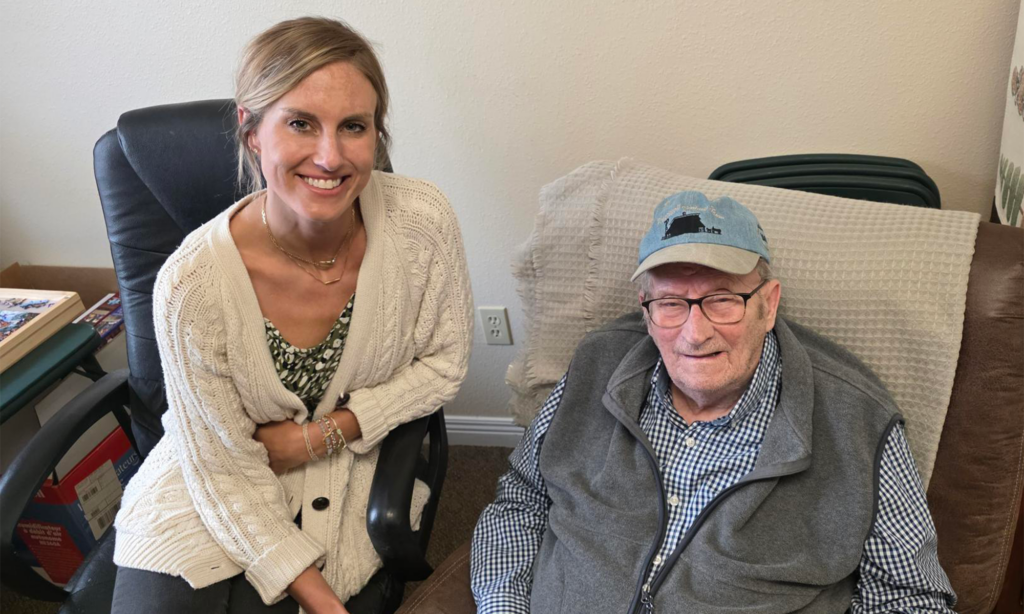
Today, Stanley lives at Edgewood East Grand Forks Memory Care, where care is shaped through an integrated partnership with Legacy Medical. Dementia has changed parts of his daily life, but it has not erased who he is.
He still enjoys puzzles. He still gravitates toward problems to solve. He still carries preferences, opinions, and a quiet humor that appear in brief, familiar moments.
Most of all, as Cathy says, “He’s still Dad.”
Within the community, care is not separated into silos. Legacy Medical Nurse Practitioner McKenzie Disrud works on-site alongside nursing staff, bringing primary care into the rhythm of daily life rather than placing it outside of it.
Care plans, medication updates, lab results, and daily observations are shared in real time across the team. Decisions are made with a shared understanding of what is changing and what it means in the context of the person, not just the condition.
“They’re still having conversations, still engaging in activities, still sharing moments with staff and each other,” McKenzie said. “Each resident truly has their own personality, and those personalities are genuinely celebrated.”
For Cathy, that recognition shows up in something simple and deeply meaningful. Every Wednesday, Stanley comes to lunch at the same time. If he is late, staff notice not because they are tracking him, but because they know him.
Care That Responds in Real Time
With dementia, change can be sudden. Having access to Legacy Medical on-site allows care to respond in real time, within the community itself.
When needed, services may include IV fluids, evaluation of acute changes, medication adjustments, GeneSight testing, and coordinated lab access through local health system partnerships. The focus is not only on treatment, but on timing responses before small changes become larger disruptions.
This approach also reduces unnecessary hospital transfers, allowing residents to remain in familiar surroundings whenever possible.
McKenzie remains in close communication with nursing throughout the day, ensuring decisions are guided by what is happening in the moment, not delayed updates.
Care That Stays Connected
Life inside the community moves between structure and spontaneity. Residents take part in programming, outings, choir, and shared activities that shape the rhythm of each day. That continuity deepens when caregivers and medical providers work side by side, guided by a shared understanding of each resident as a person first. Care becomes less fragmented and more consistent, grounded in presence rather than process.
For Cathy, the experience remains personal. Her father is still recognizable in the ways that matter most, even as other parts of life have changed.
To learn more about how Legacy Medical provides integrated primary care in memory care communities, ensuring continuity and coordinated support for Alzheimer’s disease and dementia care, contact us at info@legacymedical.com.


